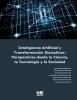
Inteligencia Artificial y Transformación Disciplinar: Perspectivas desde la Ciencia, la Tecnología y la Sociedad
Palabras clave:
Inteligencia Artificial, Tecnología, Ciencias, SociedadSinopsis
Inteligencia Artificial y Transformación Disciplinar: Perspectivas desde la Ciencia, la Tecnología y la Sociedad es un libro que presenta una visión multidisciplinaria y crítica sobre cómo la inteligencia artificial (IA) está reconfigurando sectores clave —turismo, educación, salud, consumo digital y banca— mediante automatización, análisis avanzado de datos, personalización y nuevos modelos de interacción humano‑máquina. La obra sostiene que la IA no solo optimiza procesos, sino que transforma estructuras organizacionales, prácticas profesionales, marcos éticos y relaciones sociales.
Referencias
Almomani, A., Shatat, A. S., & Khudair, H. (2023). Application of choice models in tourism recommender systems: A systematic review. Expert Systems, 40(3), e13177. https://doi.org/10.1111/exsy.13177
Banerjee, A., Banik, P., & Wörndl, W. (2023). A review on individual and multistakeholder fairness in tourism recommender systems. Frontiers in Big Data, 6, 1170180. https://pmc.ncbi.nlm.nih.gov/articles/PMC10206003/
Bigné, E., Nicolau, J. L., & William, R. (2021). Advance booking across channels: The effects on dynamic pricing. Tourism Management, 86, 104341. https://doi.org/10.1016/j.tourman.2021.104341
Bulchand Gidumal, J., & Melián González, S. (2024). Artificial intelligence’s impact on hospitality and tourism marketing: Exploring key themes and addressing challenges. Current Issues in Tourism, 27(14), 2345–2362. https://doi.org/10.1080/13683500.2023.2229480
Cai, D., Li, H., & Law, R. (2022). Anthropomorphism and OTA chatbot adoption: A mixed methods study. Journal of Travel & Tourism Marketing, 39(2), 228–255. https://doi.org/10.1080/10548408.2022.2061672
Chang, J. Y. S., Cheah, J. H., Lim, X. J., & Morrison, A. M. (2023). One pie, many recipes: The role of AI chatbots in influencing Malaysian solo traveler purchase intentions. Tourism Management Perspectives, 49, 101191. https://doi.org/10.1016/j.tmp.2023.101191
Florido Benítez, L. (2024). How Artificial Intelligence (AI) Is Powering New Tourism Marketing and the Future Agenda for Smart Tourist Destinations. Electronics, 13(21), 4151. https://doi.org/10.3390/electronics13214151
García Madurga, M. Á., & Grilló Méndez, A. J. (2023). Artificial intelligence in the tourism industry: An overview of reviews. Administrative Sciences, 13(8), 172. https://doi.org/10.3390/admsci13080172
Guizzardi, A., Pons, F. M., Ranieri, E., & Venier, F. (2022). Hotel dynamic pricing, stochastic demand and COVID 19. Tourism Economics, 28(8), 1860–1885. https://doi.org/10.1177/13548166211058561
He, K., Ji, L., Wu, C. W. D., & Tso, K. F. G. (2021). Using SARIMA–CNN–LSTM approach to forecast daily tourism demand. Journal of Hospitality and Tourism Management, 49, 25–33. https://doi.org/10.1016/j.jhtm.2021.08.022
Huang, D., Chen, Q., Huang, J., Kong, S., & Li, Z. (2021). Customer–robot interactions: Understanding customer experience with service robots. International Journal of Hospitality Management, 99, 103078. https://doi.org/10.1016/j.ijhm.2021.103078
Hu, M., Li, H., Song, H., Li, X., & Law, R. (2022). Tourism demand forecasting using tourist generated online review data. Tourism Management, 90, 104490. https://doi.org/10.1016/j.tourman.2022.104490
Ivanov, S., & Webster, C. (2017). Adoption of robots, artificial intelligence and service automation by travel, tourism and hospitality companies—A cost–benefit analysis. International Journal of Contemporary Hospitality Management, 29(8), 1935–1950. https://doi.org/10.1108/IJCHM-05-2016-0602
Law, R., Li, G., Fong, D. K. C., & Han, X. (2019). Tourism demand forecasting: A deep learning approach. Annals of Tourism Research, 75, 410–423. https://doi.org/10.1016/j.annals.2019.01.014
Li, H., Gao, H., & Song, H. (2023). Tourism forecasting with granular sentiment analysis. Annals of Tourism Research, 103, 103667. https://doi.org/10.1016/j.annals.2023.103667
Li, M., Yin, D., Qiu, H., & Bai, B. (2021). A systematic review of AI technology based service encounters: Implications for hospitality and tourism operations. International Journal of Hospitality Management, 95, 102930. https://doi.org/10.1016/j.ijhm.2021.102930
Luo, T., Zhang, X., Li, J., & Wang, Z. (2024). Travel choices and perceived images influenced by AI interactive approaches of travel apps. SAGE Open, 14(3), 21582440241290393. https://doi.org/10.1177/21582440241290393
Majid, G. M., Rasheed, M. I., Iqbal, J., & Shahzad, K. (2023). Intelligent automation for sustainable tourism: A systematic review and research agenda. Journal of Sustainable Tourism, 31(16), 3328–3354. https://doi.org/10.1080/09669582.2023.2246681
Orden Mejía, M. A., Alzate, S. P., & Garcia Murillo, L. (2023/2024). Modeling users’ satisfaction and visit intention using AI based chatbots. PLOS ONE, 18(9), e0286427. https://doi.org/10.1371/journal.pone.0286427
Orden Mejía, M. A., Fernández Gámez, M. Á., & López López, D. (2022). Estudio de caso del chatbot “Victoria la Malagueña”. Cuadernos de Turismo, 49, 275–300. https://revistas.um.es/turismo/article/view/541891
Shrestha, D., Sharma, N., & Adhikari, S. (2024). Personalized tourist recommender system: A data driven machine learning approach. Computers, 12(3), 59. https://doi.org/10.3390/computers12030059
Song, H., Qiu, R. T. R., & Park, J. (2019). A review of research on tourism demand forecasting. Annals of Tourism Research, 75, 338–362. https://doi.org/10.1016/j.annals.2018.12.001
Sousa, B., Ramos, A. F., Santos, A. C., Sousa, J., & Rachão, S. (2024). The use of Artificial Intelligence systems in tourism and hospitality: The tourists’ perspective. Administrative Sciences, 14(8), 165. https://doi.org/10.3390/admsci14080165
To, W. M., & Yu, B. T. W. (2025). Artificial intelligence research in tourism and hospitality journals: Trends, emerging themes, and the rise of generative AI. Tourism and Hospitality, 6(2), 63. https://www.mdpi.com/2673-5768/6/2/63
Tuomi, A., Tussyadiah, I., & Stienmetz, J. (2021). Applications and implications of service robots in hospitality. Journal of Hospitality & Tourism Research, 45(7), 1451–1472. https://doi.org/10.1177/1938965520923961
Tussyadiah, I. (2020). A review of research into automation in tourism. Annals of Tourism Research, 81, 102883. https://doi.org/10.1016/j.annals.2020.102883
Wu, D., Li, G., Wen, L., & Liu, X. (2023). Tourism demand forecasting with multiple mixed frequency data: A reverse MIDAS method. Journal of Travel Research. https://doi.org/10.1177/00472875231203397
Zhang, H., Liu, R., & Egger, R. (2023). Unlocking uniqueness: Analyzing online reviews of Airbnb experiences using BERT based models. Journal of Travel Research, 62(8), 1641–1661. https://doi.org/10.1177/00472875231197381
Zhang, Y., Filieri, R., & Mariani, M. (2024). Co creating with ChatGPT for tourism marketing materials. Annals of Tourism Research Empirical Insights, 5(1), 100123. https://www.sciencedirect.com/science/article/pii/S2666957924000065
Ayuso del Puerto, D., & Gutiérrez Esteban, P. (2022). La Inteligencia Artificial como recurso educativo durante la formación inicial del profesorado. RIED-Revista Iberoamericana de Educación a Distancia, 25(2), 347–362. https://doi.org/10.5944/ried.25.2.32332
Celik, I., Gedrimiene, E., Silvola, A., & Muukkonen, H. (2023). Response of learning analytics to the online education challenges during pandemic: Opportunities and key examples in higher education. Policy Futures in Education, 21(4), 387–404. https://doi.org/10.1177/14782103221078401
Cevallos Cedeño, V. C., & Aguilar Oña, K. Y. (2024). La Inteligencia Artificial en la personalización del aprendizaje en la Educación Básica Superior en una Unidad Educativa ecuatoriana. Delectus, 7(2), 68–75. https://doi.org/10.36996/delectus.v7i2.292
Chen, X., Xie, H., Zou, D., & Hwang, G.-J. (2020). Application and theory gaps during the rise of Artificial Intelligence in Education. Computers and Education: Artificial Intelligence, 1, 100002. https://doi.org/10.1016/j.caeai.2020.100002
Derlin Javier Lino, & Gladys Lola Luján. (2022). Gestión administrativa un reflejo de automatización de sistemas de control en instituciones de educación pública. Ciencia Latina Revista Científica Multidisciplinar, 6(4), 1086–1123. https://doi.org/10.37811/cl_rcm.v6i4.2645
Gómez -Mendoza, M. J., & Arroyo- Gutiérrez, A. J. (2024). El Impacto de la Inteligencia Artificial en la Educación Ecuatoriana. Revista Científica Hallazgos21, 9(2), 201–207. https://doi.org/10.69890/hallazgos21.v9i2.663
González Sánchez, M. G. (2023). Uso del sistema de información Educa y su aporte en la gestión administrativa y académica a las instituciones educativas venezolanas. Innovaciones Educativas, 25(38), 7–22. https://doi.org/10.22458/ie.v25i38.4205
Herrington, D. G., & Sweeder, R. D. (2024). Using Simulations and Screencasts in Online Preclass Activities to Support Student Building of Mental Models. Education Sciences, 14(2), 115. https://doi.org/10.3390/educsci14020115
Katsamakas, E., Pavlov, O. V., & Saklad, R. (2024). Artificial Intelligence and the Transformation of Higher Education Institutions: A Systems Approach. Sustainability, 16(14), 6118. https://doi.org/10.3390/su16146118
Lee, J., & Kim, D. (2025). From awareness to empowerment: self-determination theory-informed learning analytics dashboards to enhance student engagement in asynchronous online courses. Journal of Computing in Higher Education, 37(3), 1078–1118. https://doi.org/10.1007/s12528-024-09416-2
Marquès-Donoso, A. (2025). Inteligencia artificial en la docencia universitaria ¿Un nuevo aliado? Educación y futuro: revista de investigación aplicada y experiencias educativas, 52, 35–65. https://dialnet.unirioja.es/servlet/articulo?codigo=10195933
Mayor-Alonso, E., Vidal, J., & Rodríguez-Esteban, A. (2024). Los chatbots como herramienta de apoyo para la orientación universitaria. Edutec. Revista Electrónica de Tecnología Educativa, 87, 188–203. https://doi.org/10.21556/edutec.2024.87.2971
Mendoza Vega, A. J., Guadamud Muñoz, J. D., Santana Castro, E. K., Chiriboga Palacios, I. A., & Vera Arias, M. J. (2024). Uso De Las Plataformas de Inteligencia Artificial en el Contexto Educativo. Ciencia Latina Revista Científica Multidisciplinar, 8(1), 10996–11009. https://doi.org/10.37811/cl_rcm.v8i1.10412
Navarrete Vinces, M. E., Alegría Camino, D. M., Galarza Luna, A. F., & Ramírez Garofalo, D. A. (2025). La Inteligencia Artificial y el aprendizaje automático en Educación Superior del Ecuador. Tesla Revista Científica, 5(2), e515. https://doi.org/10.55204/trc.v5i2.e515
Ngulube, P., & Ncube, M. M. (2025). Leveraging Learning Analytics to Improve the User Experience of Learning Management Systems in Higher Education Institutions. Information, 16(5), 419. https://doi.org/10.3390/info16050419
Novita, S., Wijayanti, P. A. K., & Wedyaswari, M. (2022). Teacher Perception of Student Reading Competence and Its Relationship to Teaching Practice: A Comparison between Pre and during Pandemic Teaching in INDONESIA. Education Sciences, 13(1), 45. https://doi.org/10.3390/educsci13010045
Núñez-Michuy, C. M., Agualongo-Chela, L. M., Vistin Vistin, J. M., & López Quincha, M. (2023). La Inteligencia Artificial en la pedagogía como modelo de enseñanza. Magazine de Las Ciencias: Revista de Investigación e Innovación, 8(2), 120–135. https://doi.org/10.33262/rmc.v8i1.2932
Page, M. J., McKenzie, J. E., Bossuyt, P. M., Boutron, I., Hoffmann, T. C., Mulrow, C. D., Shamseer, L., Tetzlaff, J. M., Akl, E. A., Brennan, S. E., Chou, R., Glanville, J., Grimshaw, J. M., Hróbjartsson, A., Lalu, M. M., Li, T., Loder, E. W., Mayo-Wilson, E., McDonald, S., … Alonso-Fernández, S. (2021). Declaración PRISMA 2020: una guía actualizada para la publicación de revisiones sistemáticas. Revista Española de Cardiología, 74(9), 790–799. https://doi.org/10.1016/j.recesp.2021.06.016
Park, K., & Young Yoon, H. (2025). AI algorithm transparency, pipelines for trust not prisms: mitigating general negative attitudes and enhancing trust toward AI. Humanities and Social Sciences Communications, 12(1), 1160. https://doi.org/10.1057/s41599-025-05116-z
Pérez Imaicela, R. H. (2024). Plataforma educativa asistida por el modelo de inteligencia artificial GPT para el refuerzo académico de estudiantes del módulo tecnologías y desarrollo web en la carrera de TI de la FISEI-UTA. [Universidad Técnica de Ambato]. https://repositorio.uta.edu.ec/server/api/core/bitstreams/cb2566f2-7e1b-4357-a551-46d208947ca0/content
Reyes Román, D. M. (2025). Fundamentos de la IA generativa en el proceso de enseñanza-aprendizaje en la educación superior. Dominio de Las Ciencias, 11(2), 1152–1171. https://doi.org/10.23857/dc.v11i2.4377
Rivera Pérez, H. H., & Castillo Montes, M. V. (2025). Transformación Tecnológica e Innovación Educativa desde la Perspectiva de la Educación 4.0 a Nivel de Postgrado. Ciencia Latina Revista Científica Multidisciplinar, 9(1), 8204–8225. https://doi.org/10.37811/cl_rcm.v9i1.16470
Rodríguez Rivera, F. F., Quesada Llanto, J. C., & Poma Torres, V. C. (2025). Gestión educativa y estrategias de aprendizaje para estudiantes de una universidad privada: Una revisión sistemática. Horizontes. Revista de Investigación En Ciencias de La Educación, 9(37), 1255–1269. https://doi.org/10.33996/revistahorizontes.v9i37.982
Romero, C., & Ventura, S. (2020). Educational data mining and learning analytics: An updated survey. WIREs Data Mining and Knowledge Discovery, 10(3). https://doi.org/10.1002/widm.1355
Ruiz Muñoz, G. F., Vasco Delgado, J. C., & Alvear Dávalos, J. M. (2024). Inteligencia artificial y gobernanza en la gestión académica y administrativa de la educación superior. Revista Social Fronteriza, 4(6), e46508. https://doi.org/10.59814/resofro.2024.4(6)508
Santana Aveiga, J. R., & Hernández Rivadeneira, M. del C. (2024). Gestión Académica y Administrativa en los Procesos de Posgrado y Educación Continua. Reincisol., 3(6), 3222–3242. https://doi.org/10.59282/reincisol.V3(6)3222-3242
Simbeck, K. (2024). They shall be fair, transparent, and robust: auditing learning analytics systems. AI and Ethics, 4(2), 555–571. https://doi.org/10.1007/s43681-023-00292-7
Terreros- Pesantez, D. F., Vásquez- Erazo, E. J., & Ramon- Poma, G. M. (2025). La inteligencia artificial en la gestión administrativa docente del Instituto Tecnológico del Azuay, Cuenca, Ecuador 2025. Resistances. Journal of the Philosophy of History, 6(12), e250192. https://doi.org/10.46652/resistances.v6i12.192
Uzcátegui, R., & Ríos, M. (2024). Inteligencia artificial para la educación: formar en tiempos de incertidumbre para adelantar el futuro. Areté, Revista Digital Del Doctorado En Educación de La Universidad Central de Venezuela, 10(Edicion Especial), 1–21. https://doi.org/10.55560/arete.2024.ee.10.1
Vera-Cedeño, K., & Zaldumbide-Peralvo, D. (2024). Análisis para la implementación de un sistema de gestión organizacional para procesos de titulación del Instituto Superior Tecnológico Tsa´chila, en el periodo 2023. 593 Digital Publisher CEIT, 9(5), 765–781. https://doi.org/10.33386/593dp.2024.5.2656
Villegas-Ch, W., García-Ortiz, J., Mullo-Ca, K., Sánchez-Viteri, S., & Roman-Cañizares, M. (2021). Implementation of a Virtual Assistant for the Academic Management of a University with the Use of Artificial Intelligence. Future Internet, 13(4), 97. https://doi.org/10.3390/fi13040097
Abukari, A., Boateng, F., y Owusu, A. (2024). Students’ voices on generative AI: Perceptions, benefits, and challenges in higher education. Education and Information Technologies, 29, 13457–13478. https://doi.org/10.1007/s10639-024-13783-1
Al-Smadi, M. (2023). ChatGPT and beyond: The generative AI revolution in education. arXiv preprint, arXiv:2311.15198. https://arxiv.org/abs/2311.15198
Batista, J., Mesquita, A., y Carnaz, G. (2024). Generative AI and higher education: Trends, challenges, and future directions from a systematic literature review. Information, 15(11), 676. https://doi.org/10.3390/info15110676
Bolaño‑García, M., y Duarte‑Acosta, N. (2024). Una revisión sistemática del uso de la inteligencia artificial en la educación. Revista Colombiana de Cirugía, 73(357), Artículo 77357005. https://doi.org/10.30944/20117582.2365
Boulhrir, T., y Hamash, M. (2025). Unpacking artificial intelligence in elementary education: A comprehensive thematic analysis systematic review. Computers and Education: Artificial Intelligence, 9, 100442. https://doi.org/10.1016/j.caeai.2025.100442
Cordero, J., Torres-Zambrano, J. y Cordero-Castillo, A. (2025). Integration of generative artificial intelligence in higher education: Best practices. Education Sciences, 15(1), 32. https://doi.org/10.3390/educsci15010032
DeKorver, B. (2025). Putting inclusion into practice: Five commitments toward equity in teaching. Education Sciences, 15(1), 84. https://doi.org/10.3390/educsci15010084
García-Peñalvo, F. (2023). Educational transformation through emerging technologies: Critical review of scientific impact on learning. Education and Information Technologies, 28, 15327–15345. https://doi.org/10.1007/s10639-023-11974-4
Hernández Sampieri, R., Fernández Collado, C., y Baptista, P. (2014). Metodología de la investigación (6.ª ed.). McGraw-Hill.
Holmes, W., Porayska-Pomsta, K., y Holstein, K. (2022). Artificial intelligence in teaching and teacher professional development: A systematic review. Computers and Education, 179, 104009. https://doi.org/10.1016/j.compedu.2021.104009
Krause, S., Panchal, B. H., y Ubhe, N. (2025). Evolution of learning: Assessing the transformative impact of generative AI on higher education. Frontiers in Digital Education, 2(2), 21. https://doi.org/10.1007/s44366-025-0058-7
Lee, D., Arnold, M., Srivastava, A., Plastow, K., Strelan, P., Ploeckl, F., Lekkas, D., y Palmer, E. (2024). The impact of generative AI on higher education learning and teaching: A study of educators’ perspectives. Computers and Education: Artificial Intelligence, 6, 100221. https://doi.org/10.1016/j.caeai.2024.100221
Luo, J., Zheng, C., Yin, J. y Teo, H. H. (2025). Design and assessment of AI-based learning tools in higher education: A systematic review. International Journal of Educational Technology in Higher Education, 22, 42. https://doi.org/10.1186/s41239-025-00540-2
Maity, S., y Deroy, A. (2024). Generative AI and its impact on personalized intelligent tutoring systems. arXiv preprint, arXiv:2410.10650. https://arxiv.org/abs/2410.10650
McDonald, N., Johri, A., Ali, A., and Collier, A. H. (2025). Generative artificial intelligence in higher education: Evidence from an analysis of institutional policies and guidelines. Computers in Human Behavior: Artificial Humans, 3, 100121. https://doi.org/10.1016/j.chbah.2025.100121
Michel-Villarreal, R., Vilalta-Perdomo, E., Salinas-Navarro, D. E., Thierry-Aguilera, R., y Gerardou, F. S. (2023). Challenges and opportunities of generative AI for higher education as explained by ChatGPT. Education Sciences, 13(9), 856. https://doi.org/10.3390/educsci13090856
Rioseco País, M., Vargas Vitoria, R., Martínez Salazar, C., y Silva Quiroz, J. (2025). Towards AI education: Qualitative analysis of the perceptions of professors at a regional public university. Social Sciences & Humanities Open, 12, 101668. https://doi.org/10.1016/j.ssaho.2025.101668
Rodríguez-Triana, M. J., Prieto, L. P., y Hernández-Leo, D. (2024). In search of alignment between learning analytics and learning design: A multiple case study in a higher education institution. British Journal of Educational Technology, 55(2), 567–589. https://doi.org/10.1111/bjet.13301
Shata, A. (2025). “Opting Out of AI”: Exploring perceptions, reasons, and concerns behind faculty resistance to generative AI. Frontiers in Communication, 10, 1614804. https://doi.org/10.3389/fcomm.2025.1614804
Vieriu, A. M., y Petrea, G. (2025). The impact of Artificial Intelligence (AI) on students’ academic development. Education Sciences, 15(3), 343. https://doi.org/10.3390/educsci15030343
Wiese, L., Patil, I., Schiff, D., y Magana, A. (2025). AI ethics education: A systematic literature review. Computers and Education: Artificial Intelligence, 8, 100405. https://doi.org/10.1016/j.caeai.2025.100405
Yan, L., Sha, L., Zhao, L., Li, Y., Martinez-Maldonado, R., Chen, G., Li, X., Jin, Y., & Gašević, D. (2024). Practical and ethical challenges of large language models in education: A systematic scoping review. British Journal of Educational Technology, 55(1), 90–112. https://doi.org/10.1111/bjet.13370
Yusuf, A., Pervin, N., & Román-González, M. (2024). Generative AI and the future of higher education: A threat to academic integrity or reformation? Evidence from multicultural perspectives. International Journal of Educational Technology in Higher Education, 21, 21. https://doi.org/10.1186/s41239-024-00453-6
Agrahari, S., Singh, P., & Dwivedi, Y. K. (2022). Big data analytics for predicting online consumer behavior: A systematic review. Information Systems Frontiers, 24(5), 1421–1440. https://doi.org/10.1007/s10796-021-10229-0
Alaimo, C., & Kallinikos, J. (2021). Managing by data: Algorithmic categories and organizing. Organization Studies, 42(12), 1877–1899. https://doi.org/10.1177/0170840620934062
Borges, A., & Babin, B. J. (2020). Predicting online purchase behavior using machine learning. Journal of Retailing and Consumer Services, 54, 102019. https://doi.org/10.1016/j.jretconser.2019.102019
Chen, J., Hu, Y., & Yu, H. (2022). Big data analytics for customer behavior analysis in e-commerce. Electronic Commerce Research, 22(3), 811–836. https://doi.org/10.1007/s10660-020-09451-y
DataReportal. (2023). Digital 2023: Global overview report. https://datareportal.com/reports/digital-2023-global-overview
Davenport, T. H., & Ronanki, R. (2018). Artificial intelligence for the real world. Harvard Business Review, 96(1), 108–116.
Dunn, B. C., Frasincar, F., Matsiiako, V., Boekestijn, D., & van der Knaap, F. (2024). Bayes goes big: Distributed MCMC and the drivers of E-commerce conversion. Expert Systems with Applications, 252, 124116. https://doi.org/10.1016/j.eswa.2024.124116
Erevelles, S., Fukawa, N., & Swayne, L. (2016). Big data consumer analytics and the transformation of marketing. Journal of Business Research, 69(2), 897–904. https://doi.org/10.1016/j.jbusres.2015.07.001
Fang, Y., Wu, C., & Zhang, J. (2021). Customer segmentation using machine learning in online retail. Journal of Business Research, 134, 275–283. https://doi.org/10.1016/j.jbusres.2021.05.047
Gandomi, A., & Haider, M. (2015). Beyond the hype: Big data concepts, methods, and analytics. International Journal of Information Management, 35(2), 137–144. https://doi.org/10.1016/j.ijinfomgt.2014.10.007
Hashem, I. A. T., et al. (2022). Distributed big data analytics: A review of technologies, techniques, and trends. Information Systems, 108, 102109. https://doi.org/10.1016/j.is.2022.102109
International Telecommunication Union. (2023). Measuring digital development: Facts and figures 2023. ITU.
Katal, A., Wazid, M., & Goudar, R. H. (2013). Big data: Issues, challenges, tools and good practices. 2013 International Conference on Emerging Trends and Applications in Computer Science, 404–409. https://doi.org/10.1109/ICETACS.2013.6687623
Kumar, V., Dixit, A., Javalgi, R. G., Dass, M., & Kannan, P. K. (2022). Digital analytics: Transforming data into customer value. Journal of the Academy of Marketing Science, 50(6), 1223–1242. https://doi.org/10.1007/s11747-022-00871-3
Li, G., Pal, G., & Atkinson, K. (2023). Real-time user clickstream behavior analysis based on Apache Storm streaming. Electronic Commerce Research, 23, 1829–1859. https://doi.org/10.1007/s10660-021-09518-4
Liu, J., & Singh, A. (2021). AI-driven consumer segmentation: A review and future directions. Information Systems Frontiers, 23(6), 1473–1492. https://doi.org/10.1007/s10796-020-10097-1
Necula, S., Udriște, A., Stefan, A., Ionită, A., & Mirea, R. (2023). Exploring the impact of time spent reading product information on e-commerce websites. Behavioral Sciences, 13(6), 439. https://doi.org/10.3390/bs13060439
Nguyen, T., Simkin, L., & Canhoto, A. (2020). The dark side of digital personalization. Journal of Business Research, 116, 209–221. https://doi.org/10.1016/j.jbusres.2020.05.035
Pal, G., Atkinson, K., & Li, G. (2023). Real-time user clickstream behavior analysis based on Apache Storm streaming. Electronic Commerce Research, 23, 1829–1859. https://doi.org/10.1007/s10660-021-09518-4
Reinsel, D., Gantz, J., & Rydning, J. (2018). Data age 2025: The digitization of the world from edge to core. IDC.
Requena, B., Cassani, G., Tagliabue, J., Greco, C., & Lacasa, L. (2020). Shopper intent prediction from clickstream e-commerce data with minimal browsing information. Scientific Reports, 10(1), 16983. https://doi.org/10.1038/s41598-020-73622-y
Sarker, I. H. (2021). Machine learning for data-driven decision making: A comparative review. Electronics, 10(9), 1084. https://doi.org/10.3390/electronics10091084
Seerangan, N. K., & Shanmugam, S. V. (2021). Ensemble based temporal weighting and Pareto ranking model for effective root cause analysis. Computers, Materials & Continua, 69(1), 1367–1387. https://doi.org/10.32604/cmc.2021.012135
Shmueli, G., Bruce, P. C., Gedeck, P., & Patel, N. R. (2020). Data mining for business analytics. Wiley.
Statista. (2023). Transaction value in the digital payments segment worldwide from 2017 to 2027. https://www.statista.com/statistics/870924/digital-payments-value-worldwide/
Sun, P., Zhang, R., & Chen, X. (2022). Scalable big data analytics in cloud computing. Future Generation Computer Systems, 133, 68–80. https://doi.org/10.1016/j.future.2022.03.009
Tang, J., Wang, X., & Zhao, Y. (2021). Customer purchase prediction with deep learning in e-commerce. Electronic Commerce Research and Applications, 46, 101034. https://doi.org/10.1016/j.elerap.2021.101034
Tsai, C. W., Lai, C. F., Chao, H. C., & Vasilakos, A. V. (2015). Big data analytics: A survey. Journal of Big Data, 2(1), 21. https://doi.org/10.1186/s40537-015-0030-3
Verhoef, P. C., et al. (2021). Digital transformation and consumer behavior. Journal of Business Research, 122, 889–901. https://doi.org/10.1016/j.jbusres.2019.12.038
Wamba, S. F., et al. (2020). How big data analytics can improve firm performance. International Journal of Production Economics, 229, 107765. https://doi.org/10.1016/j.ijpe.2020.107765
Xu, H., Teo, H. H., Tan, B. C., & Agarwal, R. (2021). The role of digital platforms in reshaping consumer behavior. MIS Quarterly, 45(1), 289–314. https://doi.org/10.25300/MISQ/2021/16527
Zeng, D., Chen, H., Lusch, R. F., & Li, S. (2019). Social media analytics for smart commerce. MIS Quarterly, 43(1), 255–278. https://doi.org/10.25300/MISQ/2019/13951
Zhang, Y., & Kim, S. (2022). Distributed deep learning for large-scale consumer behavior prediction. Information Sciences, 603, 86–103. https://doi.org/10.1016/j.ins.2022.04.011
Anaya, M., & Rodríguez, C. (2021). ABC de la inteligencia artificial (IA) aplicada en la salud. Medicina, 43(4), 493–496.
Fraser, H., Coiera, E., & Wong, D. (2018). Artificial intelligence in medicine: Current trends and future possibilities. British Journal of General Practice, 68(668), 143–144. https://doi.org/10.3399/bjgp18X695213
González-Argote, J., Alonso-Galbán, P., Vitón-Castillo, A. A., Lepez, C. O., Castillo-González, W., Bonardi, M. C., & Gómez Cano, C. A. (2023). Trends in scientific output on artificial intelligence and health in Latin America in Scopus. EAI Endorsed Transactions on Scalable Information Systems, 10(4), e5. https://doi.org/10.4108/eetsis.v10i4.2963
Koteluk, O., Wartecki, A., Mazurek, S., Kołodziejczak, I., & Mackiewicz, A. (2021). How do machines learn? Artificial intelligence as a new era in medicine. Journal of Personalized Medicine, 11(1), 32. https://doi.org/10.3390/jpm11010032
Lubinus Badillo, F., Rueda Hernández, C. A., Marconi Narváez, B., & Arias Trillos, Y. E. (2021). Redes neuronales convolucionales: un modelo de Deep Learning en imágenes diagnósticas. Revisión de tema. Revista Colombiana de Radiología, 32(3), 5591–5599.
Martínez Elebi, C. (2021). Inteligencia artificial aplicada a la salud: Luces y sombras. Nueva Sociedad, (294), 109–118.
Medinaceli Díaz, K. I., & Silva Choque, M. M. (2021). Impacto y regulación de la inteligencia artificial en el ámbito sanitario. Revista del Instituto de Ciencias Jurídicas de Puebla, 15(48), 77–113. https://doi.org/10.35487/rius.v15i48.2021.1049
Morandín-Ahuerma, F., Romero-Fernández, A., & Villanueva-Méndez, L. (2023). Inteligencia artificial aplicada a la salud: Pronóstico reservado. Investigación en Educación Médica, 12(46), 101–102. https://doi.org/10.22201/facmed.20075057e.2023.46.24760
Sánchez Madriz, L. J., Soto Benavides, D. C., Shion Pérez, J. F., Palma González, L. D., & Camacho Arias, N. P. (2024). Inteligencia artificial aplicada al diagnóstico médico: Una revisión actual. Revista Científica de Salud y Desarrollo Humano, 5(2), 274–288. https://doi.org/10.53732/rcsydh.v5i2.180
Aguiar-Costa, L. M., Cunha, C. A. X. C., Silva, W. K. M., & Abreu, N. R. (2022). Customer satisfaction in service delivery with artificial intelligence: A meta-analytic study. Revista de Administracao Mackenzie, 23(6). https://doi.org/10.1590/1678-6971/eRAMD220003.en
Alenizi, A., Mishra, S., & Baihan, A. (2024). Enhancing secure financial transactions through the synergy of blockchain and artificial intelligence. Ain Shams Engineering Journal, 15(6). https://doi.org/10.1016/j.asej.2024.102733
Baffour Gyau, E., Appiah, M., Gyamfi, B. A., Achie, T., & Naeem, M. A. (2024). Transforming banking: Examining the role of AI technology innovation in boosting banks financial performance. International Review of Financial Analysis, 96. https://doi.org/10.1016/j.irfa.2024.103700
Braga, C. M., Serrano, M. A., & Fernández-Medina, E. (2025). Towards a methodology for ethical artificial intelligence system development: A necessary trustworthiness taxonomy. Expert Systems with Applications, 286. https://doi.org/10.1016/j.eswa.2025.128034
Buczynski, W., Steffek, F., Jamnik, M., Cuzzolin, F., & Sahakian, B. (2025). Future themes in regulating articial intelligence in investment management. Computer Law & Security Review, 56. https://doi.org/10.5281/zenodo.2612537
Chen, Y., Du, L., Zhang, B., Wang, L., Wang, K., Huang, X., & Shi, Y. (2025). The impact of artificial intelligence on the sustainability of international trade enterprises. International Review of Economics and Finance, 101. https://doi.org/10.1016/j.iref.2025.104136
Espinoza, S. C. R. (2025). Relación comercial banca clientes desde la implementación de la IA. Yashasun, 16, 1–23. https://doi.org/https://editorialibkn.com/index.php/Yachasun/article/view/695
Fenerich, A., Steiner, M. T. A., Steiner Neto, P. J., Tochetto, E., Tsutsumi, D., Assef, F. M., & Dos Santos, B. S. (2020). Use of machine learning techniques in bank credit risk analysis. Revista Internacional de Metodos Numericos Para Calculo y Diseno En Ingenieria, 36(3), 1–15. https://doi.org/10.23967/J.RIMNI.2020.08.003
Graham, G., Nisar, T. M., Prabhakar, G., Meriton, R., & Malik, S. (2025). Chatbots in customer service within banking and finance: Do chatbots herald the start of an AI revolution in the corporate world? Computers in Human Behavior, 165. https://doi.org/10.1016/j.chb.2025.108570
Ho, H., Han, S. M., Cha, J., & Pham, L. (2025). Mobile Banking Customer Satisfaction and Loyalty: The Roles of Technology Readiness. Journal of Risk and Financial Management, 18(7). https://doi.org/10.3390/jrfm18070403
Ikhsan, R. B., Fernando, Y., Prabowo, H., Yuniarty, Gui, A., & Kuncoro, E. A. (2025). An empirical study on the use of artificial intelligence in the banking sector of Indonesia by extending the TAM model and the moderating effect of perceived trust. Digital Business, 5(1), 1–15. https://doi.org/10.1016/j.digbus.2024.100103
Liu, Z., & Kong, T. (2025). Evaluation of Enterprise Internal Control Based on Artificial Intelligence. Procedia Computer Science, 262, 1217–1227. https://doi.org/10.1016/j.procs.2025.05.163
Martínez-Moreno, J., & Petko, D. (2024). What motivates future teachers? The influence of Aartificial Iintelligence on student eachers’ career choice. Computers and Education: Artificial Intelligence, 7. https://doi.org/10.1016/j.caeai.2024.100296
Mi Alnaser, F., Rahi, S., Alghizzawi, M., & Ngah, A. H. (2023). Does artificial intelligence (AI) boost digital banking user satisfaction? Integration of expectation confirmation model and antecedents of artificial intelligence enabled digital banking. Heliyon, 9(8). https://doi.org/10.1016/j.heliyon.2023.e18930Noreen, U., Shafique, A., Ahmed, Z., & Ashfaq, M. (2023). Banking 4.0: Artificial Intelligence (AI) in Banking Industry & Consumer’s Perspective. Sustainability (Switzerland), 15(4). https://doi.org/10.3390/su15043682
Pattnaik, D., Ray, S., & Raman, R. (2024). Applications of artificial intelligence and machine learning in the financial services industry: A bibliometric review. Heliyon, 10(1), 1–19. https://doi.org/10.1016/j.heliyon.2023.e23492
Polireddi, N. S. A. (2024). An effective role of artificial intelligence and machine learning in banking sector. Measurement: Sensors, 33, 101135. https://doi.org/10.1016/j.measen.2024.101135
Przychodzen, W. (2024). Political factors in renewable energy generation: Do populism, carbon tax and feed-in tariffs matter? Energy Research & Social Science, 115, 103628. https://doi.org/10.1016/J.ERSS.2024.103628
Shaikh, I. A. Ha. N. K. S. J. (2023). ISLAMIC BANK CUSTOMERS ADOPTION. Journal of Islamic Monetary Economics and Finance, 57–70. https://doi.org/https://doi.org/10.21098/jimf.v9i1.1545
Vecchietti, G., Liyanaarachchi, G., & Viglia, G. (2025a). Managing deepfakes with artificial intelligence: Introducing the business privacy calculus. Journal of Business Research, 186. https://doi.org/10.1016/j.jbusres.2024.115010
Vecchietti, G., Liyanaarachchi, G., & Viglia, G. (2025b). Managing deepfakes with artificial intelligence: Introducing the business privacy calculus. Journal of Business Research, 186. https://doi.org/10.1016/j.jbusres.2024.115010
Vuković, D. B., Dekpo-Adza, S., & Matović, S. (2025). AI integration in financial services: a systematic review of trends and regulatory challenges. In Humanities and Social Sciences Communications (Vol. 12, Issue 1). Springer Nature. https://doi.org/10.1057/s41599-025-04850-8
Wang, X., Lin, X., & Shao, B. (2022). How does artificial intelligence create business agility? Evidence from chatbots. International Journal of Information Management, 66. https://doi.org/10.1016/j.ijinfomgt.2022.102535
Wu, X. (2025). Securing the economic management and service infrastructure of banks via the use of artificial intelligence (MO-ILSTM). Systems and Soft Computing, 7. https://doi.org/10.1016/j.sasc.2025.200227
Descargas
Publicado
Licencia

Esta obra está bajo una licencia internacional Creative Commons Atribución-NoComercial 4.0.